
La Paz's Libramiento Norte down to one lane from October 6 for resurfacing
The State Road Board is investing 10 million pesos in the stretch between the Pichilingue junction and Colosio Boulevard; traffic will move in controlled, alternating turns.
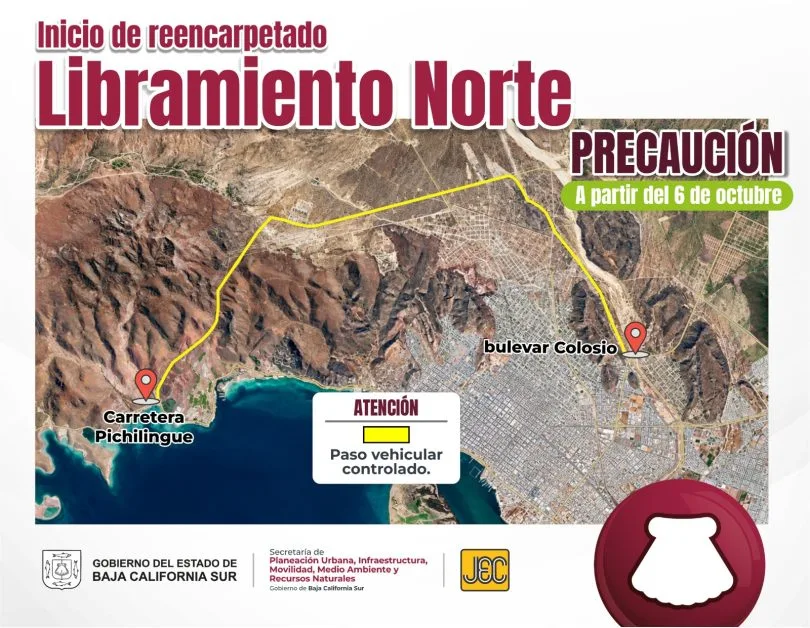
Baja California Sur's State Road Board (Junta Estatal de Caminos, JEC) begins rehabilitating La Paz's Libramiento Norte on Tuesday, October 6, along the stretch from the junction with the Pichilingue highway to the intersection with Colosio Boulevard. While work is underway, traffic will run on a single open lane with controlled, alternating passage.
According to the state government, the project carries an investment of 10 million pesos. JEC director general Jorge Alberto Cota Pérez said the work includes recovering the existing pavement, treating and compacting the base layer, priming, and laying hot-mix asphalt.
The agency will also patch potholes and renew road signage along the stretch. The official notice does not specify the total duration of the project or daily work hours.
What it means for drivers
Libramiento Norte links the road to Pichilingue, home to the ferry terminal, with Colosio Boulevard, so it carries freight, ferry-bound travelers and residents of the city's northern neighborhoods. With only one lane available, longer travel times are likely, especially at rush hour.
The JEC asked drivers to obey speed limits and follow the instructions of crews managing traffic in the work zone.
Practical tips
- Leave early if you have a ferry booking or a fixed delivery time: alternating passage means waits.
- Slow down approaching the work zone and do not pass on the single-lane section.
- Follow the flagger: alternating traffic depends on their signals.
- Consider alternate in-city routes if you are not heading to Pichilingue or the north side.
- Watch for machinery and loose material, especially during pavement removal and hot asphalt laying.
Background
The project follows an intense rainy season in the south of the state, including hurricanes Polo and Rachel in late September and early October. Heavy rain tends to speed up pavement wear and pothole formation, which is why patching is part of the job.
Questions or reports about the project can be directed to the Baja California Sur State Road Board.
Related
The monthly report also lists 50 fires and 15 gas leaks in a month marked by Hurricane Polo.
Motor graders and dump trucks are working in Mesa Colorada 3, Rosa Delia, Centro, Las Brisas, Los Cangrejos and Leonardo Gastélum. Drivers are asked to slow down near work zones.
Public Services is using heavy machinery on avenues including Nicolás Tamaral and Leona Vicario, in the Cangrejos, Jacaranda and Centro neighborhoods.
Route 1 serves 33 schools and Route 2 serves 15; the pass gives students a reduced fare per ride.